

Retail executives face mounting pressure to select merchant incentives that genuinely drive customer engagement and sales growth. With countless options ranging from simple discounts to sophisticated loyalty programs, choosing the right approach requires a strategic framework. This article walks you through proven evaluation criteria, showcases real-world examples across consumer and partner channels, and provides actionable comparisons to help you make informed decisions. You will learn how to assess incentive effectiveness using ROI metrics, sales cycle data, and retention benchmarks that align with your business goals.
Table of Contents
- Criteria For Evaluating Merchant Incentives
- Examples Of Direct Consumer Incentives
- Channel And Partner Incentives For Merchant Networks
- Payment Network And Loyalty Program Incentives
- Comparing Merchant Incentives: Features And Strategic Fit
- Explore Enigmatic Smile Solutions For Powerful Merchant Incentives
Key takeaways
| Point | Details |
|---|---|
| Evaluation framework | Match incentives to your business using ROI, margin protection, sales cycle speed, retention, and implementation ease criteria |
| Rewards outperform discounts | Rewards programs deliver 16% higher marketing ROI and accelerate sales cycles by 36% compared to simple discounts |
| Channel incentives matter | Dealer and partner programs using volume bonuses and SPIFFs drive distribution network performance and shelf share |
| Loyalty programs win long-term | Member revenue lifts range from 10 to 25% with retention improvements of 5 to 20% over non-members |
| Measure what matters | Use KPI trees to track uplift and incrementality, ensuring every incentive dollar generates measurable business impact |
Criteria for evaluating merchant incentives
Selecting the right merchant incentive starts with a clear evaluation framework. You need criteria that connect directly to business outcomes rather than gut feelings or competitor mimicry. The most effective approach balances five core dimensions: ROI impact, margin protection, sales cycle acceleration, customer retention potential, and implementation complexity.
ROI impact measures the revenue generated per dollar spent on incentives. Rewards outperform discounts by protecting margins, accelerating sales cycles, and increasing marketing ROI. Margin protection ensures your incentive strategy does not erode profitability through excessive discounting. Sales cycle acceleration tracks how quickly incentives convert prospects into buyers, a critical metric for cash flow management.
Customer retention reveals whether your incentive builds lasting relationships or simply attracts bargain hunters who disappear after one transaction. Implementation ease considers the operational lift required to launch and manage the program, including technology integration, staff training, and ongoing administration.
Measuring uplift and incrementality using KPI trees transforms subjective opinions into data-driven decisions. A KPI tree breaks down your primary business goal into contributing factors, letting you isolate the specific impact of each incentive type. For example, if your goal is revenue growth, your tree might branch into new customer acquisition, repeat purchase rate, and average order value. You can then track how purchasing power incentives influence each branch.
Pro Tip: Build a simple scorecard rating each potential incentive on a scale of 1 to 5 across all five criteria, then multiply by your priority weighting for each dimension to generate an objective comparison score.
Additional considerations include budget constraints, customer segment preferences, competitive positioning, and channel-specific dynamics. B2B contexts often require different incentive structures than B2C environments. Your customer data should reveal which incentive types resonate most with your target segments, whether that means experiential rewards for high-value accounts or instant discounts for price-sensitive shoppers.
Examples of direct consumer incentives
Direct consumer incentives create immediate purchase motivation by reducing friction or increasing perceived value at the point of sale. Sales promotions such as discounts, flash sales, buy-one-get-one, and gifts with purchase effectively stimulate consumer buying behavior across retail categories. Each type serves distinct strategic purposes and generates different behavioral responses.

Discounts remain the most straightforward approach, reducing the purchase price by a percentage or fixed amount. Flash sales compress the decision window, creating urgency through time-limited offers that drive rapid conversion. BOGO deals increase basket size by rewarding multiple-item purchases, particularly effective for inventory clearance or introducing new products alongside established favorites.
Gifts with purchase add perceived value without directly cutting prices, protecting your margin while creating excitement around the transaction. This approach works especially well for premium brands that want to maintain price integrity while still offering compelling incentives. Beauty retailers frequently use this tactic, bundling deluxe samples with full-size purchases to introduce customers to additional product lines.
Schutz provides a strong retailer case example with their Friends and Family exclusive sale events. These private sales create VIP experiences for existing customers, combining percentage discounts with early access to new collections. The exclusivity factor strengthens brand loyalty while the time limitation drives concentrated sales volume within a controlled period.
These consumer incentive strategies influence behavior through multiple psychological mechanisms. Discounts trigger loss aversion, making customers fear missing out on savings. Urgency activates scarcity bias, pushing faster decisions with less deliberation. Gifts activate reciprocity norms, making customers feel obligated to complete the purchase. Understanding these mechanisms helps you select incentives that align with your specific conversion goals and customer psychology.
Short-term sales uplifts from consumer incentives typically range from 20% to 300% depending on offer depth and promotion visibility. However, customer acquisition costs matter more than raw sales spikes. Calculate the lifetime value of customers acquired through each incentive type to determine true program effectiveness beyond the initial transaction.
Channel and partner incentives for merchant networks
Channel and partner incentives target the dealers, distributors, and resellers who push your products through multi-tier retail ecosystems. These programs align partner motivations with your business objectives, creating a multiplier effect as each incentivized partner influences dozens or hundreds of end customers.
Dealer and partner incentives include volume bonuses, tiered rewards, and SPIFFs to boost sales performance across distribution networks. Volume bonuses reward partners who exceed predetermined sales thresholds, typically structured as quarterly or annual payouts that increase percentage-wise at higher tiers. This approach encourages sustained effort rather than one-time pushes.
Tiered rewards create achievement levels that partners strive to reach, with escalating benefits at each tier. A bronze partner might earn 5% back on sales, silver partners 8%, and gold partners 12%, with tier status determined by trailing 12-month volume. This structure motivates partners to grow their business with your brand specifically rather than splitting attention across multiple vendors.
SPIFFs (Sales Performance Incentive Funds) provide immediate, short-term rewards for selling specific products or achieving tactical goals. A manufacturer launching a new product line might offer $50 per unit sold during the first quarter, giving sales representatives direct financial motivation to feature that product in customer conversations. SPIFFs work best for time-sensitive objectives like new product introductions or inventory clearance.
These incentives influence partner behavior by making your products more profitable to sell than competitor alternatives. When a sales representative can earn higher commissions or bonuses from your brand, they naturally prioritize your products in customer recommendations. This translates to increased share of shelf, better product placement, and more enthusiastic sales presentations.
Channel incentives also accelerate sales cycles by reducing partner hesitation around inventory risk and customer acquisition costs. When partners know they will receive volume bonuses, they invest more confidently in marketing your products and maintaining adequate stock levels. This creates a virtuous cycle where better availability and promotion drive higher sales, which generate larger bonuses, which fund further investment in your partner incentive programs.
Payment network and loyalty program incentives
Payment networks and loyalty programs create structurally embedded incentives that drive sustained customer engagement beyond one-time promotions. Payment networks fund consumer rewards through merchant fees, creating a complex ecosystem where merchants effectively subsidize customer incentives in exchange for transaction volume and data insights. This model faces challenges around transparency, cost control, and value attribution.
The comparison between incentive types reveals stark performance differences:
| Incentive Type | Marketing ROI | Sales Cycle Impact | Margin Protection | Retention Lift | | --- | --- | --- | --- | | Discounts | Baseline | Baseline | Poor (direct margin erosion) | Minimal (attracts bargain hunters) | | Rewards/Incentives | 16% higher than discounts | 36% faster sales cycles | Good (preserves price integrity) | Moderate (builds preference) | | Loyalty Programs | 3 to 10 times higher | Sustained acceleration | Excellent (increases LTV) | Strong (5 to 20% improvement) |
Loyalty programs deliver member revenue uplift of 10 to 25% compared to non-members, with retention improvements in the 5 to 20% range. These programs work by creating psychological ownership and sunk cost bias. As customers accumulate points or tier status, they become increasingly reluctant to switch to competitors where they would start from zero.
The sustained engagement from loyalty programs generates compound benefits over time. Members visit more frequently, spend more per transaction, and provide valuable zero-party data through program interactions. This data enables personalized offers that further increase conversion rates and customer satisfaction.
Pro Tip: In B2B contexts, balance financial rewards with experiential incentives like exclusive training, early product access, or executive briefings to maximize engagement across different stakeholder motivations within customer organizations.
Payment network incentives through payment network incentives explained platforms offer merchants standardized infrastructure for deploying purchasing power across transactions. However, merchants must carefully evaluate the total cost of participation, including interchange fees, program administration, and opportunity costs of customer data sharing. The most sophisticated retailers now build proprietary loyalty programs that give them full control over customer relationships and incentive economics.
Comparing merchant incentives: features and strategic fit
A comprehensive comparison helps you select incentives that match your specific business context, budget constraints, and strategic priorities. The table below summarizes key features, advantages, limitations, and ideal use cases:
| Incentive Category | Primary Benefit | Implementation Complexity | Best For | Key Limitation |
|---|---|---|---|---|
| Sales Promotions | Immediate sales spike | Low (existing POS systems) | Quick inventory turns, new customer acquisition | Margin erosion, no lasting loyalty |
| Dealer/Partner Programs | Channel leverage | Medium (tracking and payout systems) | Multi-tier distribution, B2B sales | Requires partner management infrastructure |
| Payment Network Rewards | Broad consumer reach | High (network integration) | High transaction volume merchants | Loss of customer data control, ongoing fees |
| Proprietary Loyalty | Maximum customer LTV | High (custom platform build) | Repeat purchase businesses, premium brands | Upfront technology investment |
Sales promotions work best when you need immediate results and have healthy margins to absorb discounting. They excel at clearing seasonal inventory, introducing new products, or responding to competitive threats. However, frequent discounting trains customers to wait for sales, undermining full-price sales over time.
Dealer and partner incentives make sense when your go-to-market strategy relies on independent resellers or franchisees. The leverage effect multiplies your marketing investment as each motivated partner promotes your products to their customer base. Budget requirements scale with partner network size, but the ROI typically justifies the investment through increased distribution reach.
Payment network rewards suit merchants with high transaction volumes who want to tap into established consumer behaviors around credit card rewards and cashback. The tradeoff involves sharing customer data and paying ongoing network fees. Smaller merchants may find these costs prohibitive relative to the incremental sales generated.
Proprietary loyalty programs require significant upfront investment but deliver the highest long-term ROI for businesses with repeat purchase cycles. You maintain complete control over customer data, program economics, and member experiences. This approach works best when you have the scale to justify custom platform development and the operational capability to manage ongoing program administration.
Strategic fit depends on your customer lifetime value, purchase frequency, competitive intensity, and available resources. High-LTV businesses should prioritize loyalty programs that maximize retention. Transaction-based businesses benefit more from point-of-sale promotions that increase basket size. Channel-dependent businesses must invest in partner incentives to maintain distribution leverage.
The merchant incentive comparison ultimately comes down to matching program characteristics with your business model and growth stage. Early-stage companies often start with simple promotions, graduate to loyalty programs as they scale, and eventually layer in partner incentives when expanding distribution.
Explore Enigmatic Smile solutions for powerful merchant incentives
Applying the evaluation criteria and examples from this article requires infrastructure that can deploy, track, and optimize incentives at scale. Enigmatic Smile provides a clearing network that sits above global payment systems, converting fragmented promotional value into standardized purchasing power. This approach solves the interoperability challenge where hundreds of billions in retailer incentives remain siloed and inefficient.
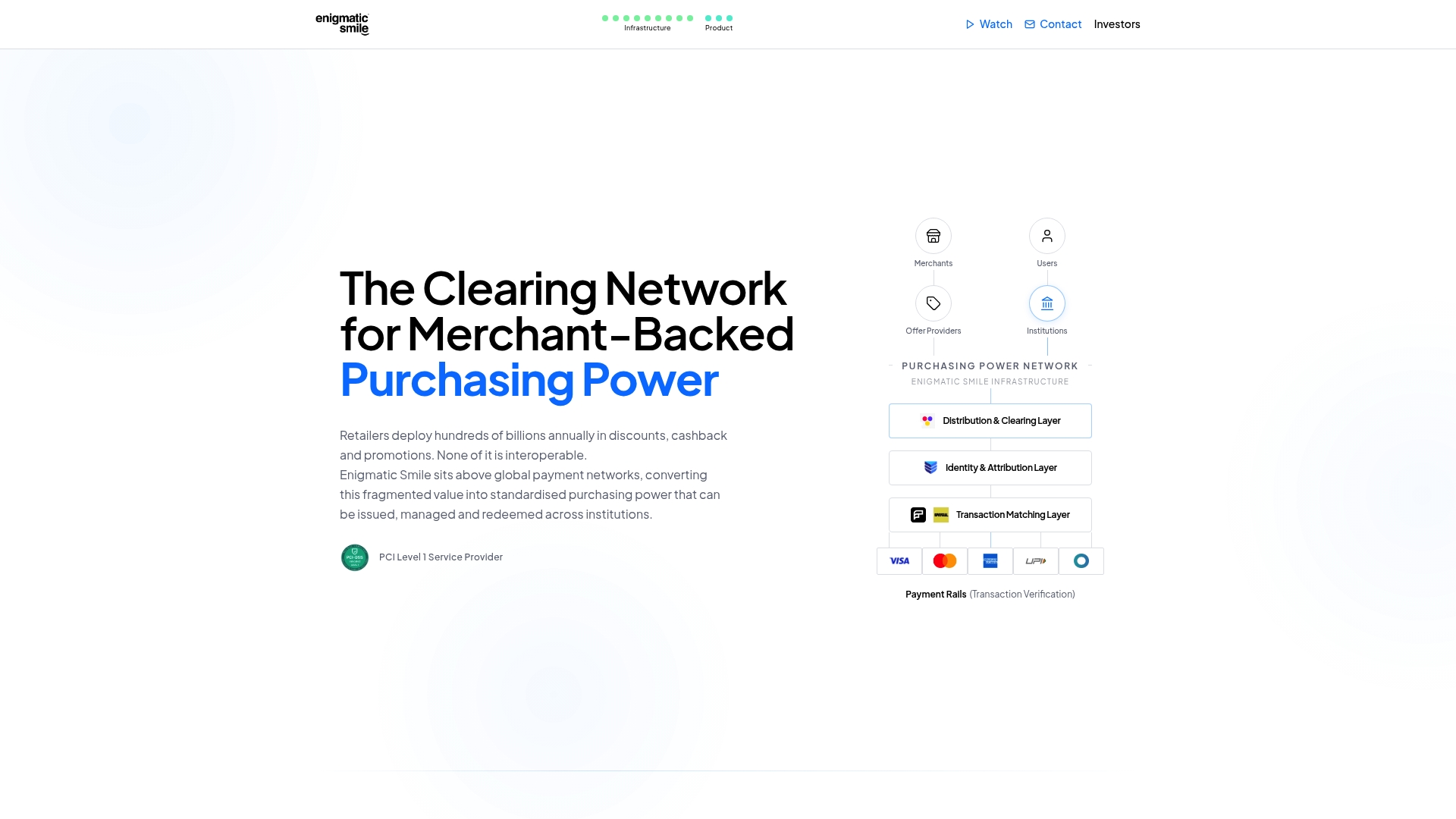
The Enigmatic Smile platform enables precise control over how purchasing power flows across your customer base and partner network. You can issue targeted incentives, manage redemption rules, and measure incremental lift using integrated analytics. This infrastructure transforms incentive programs from operational burdens into strategic growth engines.
Explore purchasing power control solutions designed specifically for retail executives who need to maximize engagement and ROI from every incentive dollar. The platform handles the technical complexity while you focus on strategic decisions about which incentives to deploy and when.
Frequently asked questions
What are merchant incentives and why are they important?
Merchant incentives are financial or experiential rewards designed to motivate specific consumer or partner behaviors that drive business results. They matter because effective incentives increase customer loyalty, accelerate sales cycles, and improve marketing ROI compared to passive strategies. In competitive retail environments, well-designed incentives differentiate your brand and create sustainable advantages through behavioral conditioning and relationship building.
How do loyalty programs compare to discount-based promotions?
Loyalty programs deliver 3 to 10 times higher ROI than discount promotions while generating 5 to 20% better customer retention rates. Discounts create immediate sales spikes but erode margins and attract price-sensitive customers who lack brand loyalty. Loyalty programs build lasting relationships through accumulated value and psychological ownership, making them superior for businesses focused on customer lifetime value rather than one-time transactions.
What are examples of effective partner incentives?
Effective partner incentives include volume bonuses that reward sales threshold achievement, tiered reward structures that create advancement motivation, and SPIFFs that drive focus on specific products or time periods. These programs work by aligning partner profitability with your business objectives, making your products more attractive to sell than competitor alternatives. The best programs combine financial rewards with operational support like training, marketing materials, and dedicated account management.
How can merchants measure the success of their incentive programs?
Use KPI trees to break down primary business goals into measurable components, then track uplift and incrementality for each incentive type across relevant metrics. Focus on incremental revenue per incentive dollar spent, customer acquisition cost, retention rate changes, and sales cycle duration. Regular analysis comparing incentivized versus control groups reveals true program impact beyond baseline trends, enabling continuous optimization and budget reallocation toward highest-performing tactics.